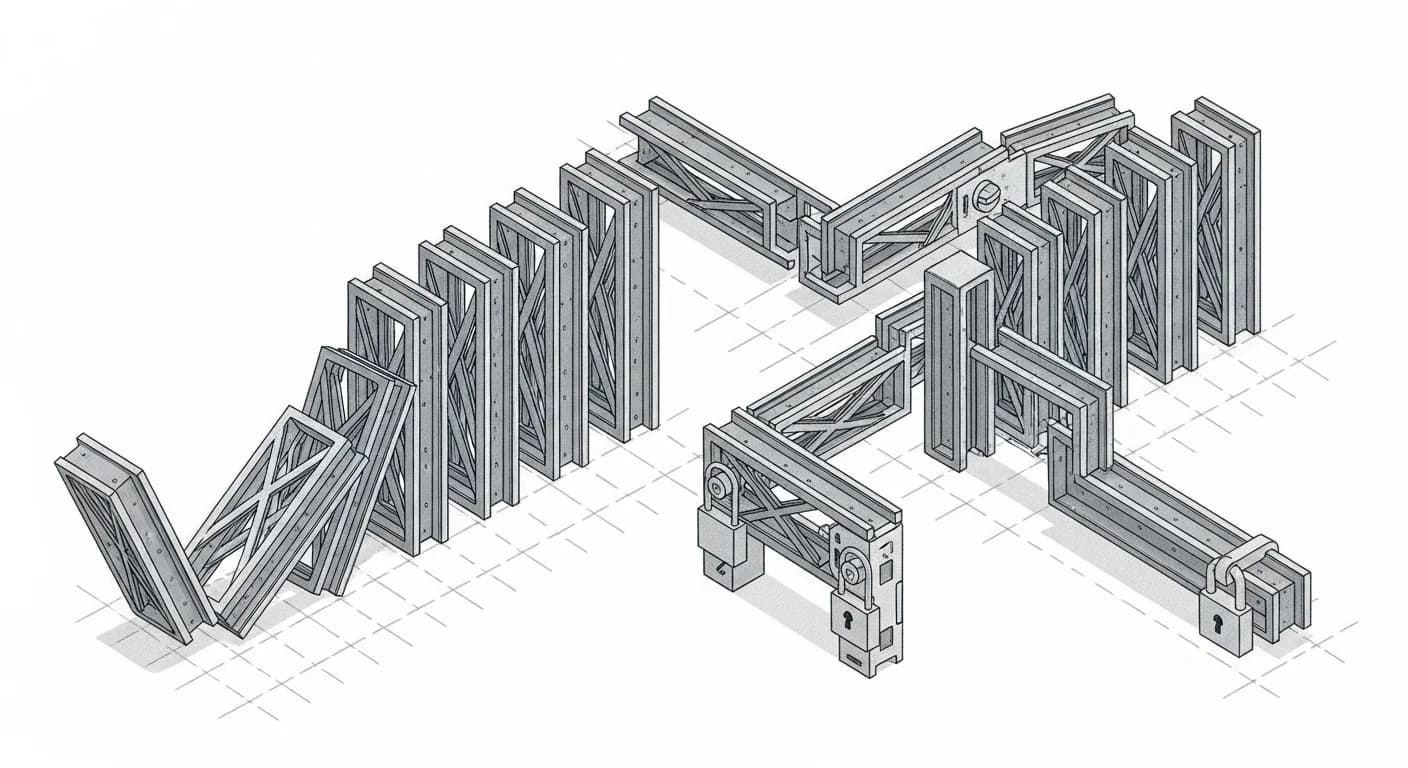
Delaying Structure Decisions Locks Future Options
Every month of delay in making entity and tax decisions embeds precedent that makes future corrections harder and more expensive to unwind.
Some links on this page go to partners who compensate us. This does not affect our analysis or rankings. How we make money
Solo founders make decisions under pressure. Form the entity before revenue arrives. Open the bank account before the processor can connect. File the taxes before the deadline. Each decision feels standalone.
It isn't. Every choice sets conditions for the next one. And the order you make them in matters more than whether any single one is "correct."
The sequence matters more than the individual decision
Most founders evaluate decisions on their merits. Is this the right entity type? The right bank? The right jurisdiction? Reasonable questions, answered one at a time with the best information available.
What nobody examines is the chain reaction. Your LLC type in month one dictates which banks will accept you in month two. The bank you open dictates which processors connect in month three. The processor dictates how revenue flows by month six.
Every individual decision was fine. But the sequence built a dependency chain that now fights you when you try to change anything. The first-year decision map sequences these choices to minimize downstream lock-in.
Dependencies accumulate quietly
Early decisions feel reversible. "I can always restructure the entity." "I can switch banks later." "The tax position is adjustable."
In practice, reversibility decays fast. That flexible LLC now has contracts hanging off it, bank accounts tied to it, tax filings referencing it, and processors routing through it. Restructuring means unwinding all of that at once. A simple month-one decision becomes a twelve-month extraction project.
The worst part: you won't feel it happening. Everything runs smoothly as long as you keep moving in the same direction. The constraints only surface the moment you try to change course, and by then the cost of adjustment has quietly multiplied.
How does your structure score?
Free 2-minute screening across Money, Entity, Tax, and Accountability.
The three dependency patterns
Structural dependency. Your entity type determines what financial infrastructure you can access. A US LLC opens certain banking and processing options; a different entity type opens different ones. Once the LLC is operating, everything sits on top of it. Changing the entity means rebuilding the entire stack. The US LLC formation guide covers the initial decision, but what it creates downstream matters more.
Jurisdictional dependency. Where you form, where you bank, and where you file taxes all interact. A tax position claimed in one country may depend on entity substance in another. Banking in a third country may require consistency with both. These dependencies cross borders and institutional contexts, which makes them hard to even see, let alone untangle. The tax residency guide outlines how jurisdictions assess residency. The OECD model tax convention and bilateral tax treaties are supposed to resolve conflicting claims, but in practice the interactions with entity and banking decisions are rarely straightforward.
Temporal dependency. Early decisions set precedents. A tax filing that treated income one way creates an expectation of consistency in future filings. A bank application that described the business one way creates a record that subsequent interactions must match. The longer a pattern persists, the harder it is to deviate. The narrative consistency analysis maps how descriptions given to different institutions at different times create a fragmented picture that resists correction.
Why "I'll fix it later" rarely works
You see the problem. The business is running. Revenue is flowing. Fixing it now means disruption, so you defer.
I get it. The cost of fixing today is concrete: time, money, operational chaos. The cost of the dependency feels abstract. Something for later.
Here is the trap: deferral compounds. Every month you keep operating under the current structure adds another layer of records, filings, and institutional relationships that the eventual correction must address. The cost of fixing it grows steadily, while the urgency stays invisible. The timing trap analysis maps the three forces (information, capacity, and cost) that keep pushing founders toward "later."
Information arrives after the decision
The cruel part: you usually learn how decisions interact only after you have already made them.
Tax implications become clear after the entity is formed. Banking constraints surface after the account is open. Processor limitations appear after revenue is flowing. The information that would have changed your sequence shows up too late.
This is not carelessness. You literally cannot know how these pieces interact until the interaction generates the evidence. The S-Corp election is a sharp example: the Form 2553 has a narrow filing window, and founders who discover the benefit after the deadline has passed wait a full year for the next shot.
Capacity constraints make it worse
When you are simultaneously deciding on entity restructuring, banking, and tax positions, cognitive load wins. You stop optimizing the sequence and start clearing the most urgent item off your desk.
So the entity question gets resolved first because it feels pressing, not because it should logically precede the banking decision. Then banking gets resolved because the entity choice created an immediate need. Opening a Mercury account because it connects to Stripe feels like progress, but that decision constrains how you handle international revenue through Wise. The banking comparison maps these trade-offs.
Each decision relieves immediate pressure while quietly creating the next round of constraints. The entity decision framework shows how four variables (citizenship, tax residency, revenue geography, growth trajectory) interact to narrow your options.
Mapping dependencies before they constrain
The point of examining decision sequences is not to find the optimal path. In cross-border structures, the optimal path is almost never knowable in advance. The point is to see which dependencies already exist, which future options they block, and where flexibility remains before it erodes further.
Global Solo's META framework maps these dependencies across four dimensions: how Money flow interacts with Entity structure, how Tax positions depend on both, and how Accountability documentation either supports or undermines the whole sequence. The cross-border compliance checklist is a concrete starting point for identifying which dependencies have already formed in your setup.
Visual: Decision Dependency Chain
| Stage | Detail | Risk |
|---|---|---|
| Month 1 | Form Delaware LLC | — |
| Month 2 | Bank Options Limited, to DE LLC Non-Resident | — |
| Month 3 | Stripe Connected, to Mercury | — |
| Month 6 | Revenue Path Embedded, Stripe→Mercury→Personal | — |
| Month 12 | Want to Restructure?, Must Migrate Everything | — |
| Low Cost | Low | |
| Medium Cost | Medium | |
| Embedded | Dependencies | High |
Key Takeaways
- The entity type chosen in month one determines which bank accounts can be opened in month two, which determines which processors connect in month three — the sequence creates a dependency chain that resists adjustment.
- Reversibility of structural decisions degrades over time; an entity that felt flexible when formed accumulates contracts, bank accounts, and tax filings that make restructuring exponentially more costly.
- The information needed to evaluate a decision sequence often arrives only after the sequence is established — tax implications clarify after the entity operates, banking constraints surface after account history accumulates.
- Deferring correction itself becomes a dependency: each period of continued operation adds records and relationships that increase the eventual cost of change.
References
- IRS LLC Guidance — Entity classification and tax treatment
- IRS Form 2553 (S-Corp Election) — Election timing and requirements
- IRS Filing Information — Federal tax filing requirements and deadlines
- IRS Tax Treaties — US bilateral tax treaty list
- OECD Model Tax Convention — Framework for bilateral tax treaties
- Mercury — Banking for startups
- Wise — Multi-currency business accounts
- Stripe — Payment processing for internet businesses
Disclosure
*Mercury is a fintech company, not an FDIC-insured bank. Banking services provided through Choice Financial Group and Column N.A., Members FDIC.
META — Accountability
Accountability — Documentation & Audit Readiness — 13 articlesRelated Tools
Related Articles
Why Waiting to Incorporate Costs More Than Starting
Deferring LLC formation and entity decisions feels safe. But waiting accumulates dependencies, closes options, and creates the mess it was meant to avoid.
AI Writes Your Risk Report. It Doesn't Score It.
How Global Solo uses AI for language while keeping risk scores, structure, and boundaries fully deterministic. A look inside the META diagnostic engine.
The META Framework: Four Dimensions of Structural Risk
META maps structural risk across four dimensions — Money, Entity, Tax, Accountability — so cross-border founders see where complexity concentrates.
First Year Cross-Border Founder: Every Decision Map
LLC or sole prop? Which state? Bank where? Month-by-month map of every structural decision cross-border founders face in year one.
How a Non-Resident-Owned US LLC Is Taxed (2026)
Two questions decide a non-resident's US tax on a single-member LLC: US trade or business, and income source. Plus Form 5472, 1040-NR, FDAP and treaties.
Summarize with AI

Cross-border entrepreneur running businesses across the US, China, and beyond for 20+ years. I built Global Solo to map the structural risks I wish someone had shown me.
Where does your structure have gaps?
Two free ways to map your cross-border risk — pick the depth that fits your time.
Structural Patterns
One blind spot, every two weeks. For entrepreneurs operating across borders.
Free LLC Formation Checklist included